

Pine Tree
Pines are evergreen, coniferous resinous trees (or rarely shrubs) growing 3–80 m tall, with the majority of species reaching 15–45 m tall. The smallest are Siberian dwarf pine and Potosi pinyon, and the tallest is a 268.35-feet (81.79-meter) tall ponderosa pine located in southernOregon's Rogue River-Siskiyou National Forest.[6]
Bark chips
The bark of most pines is thick and scaly, but some species have thin, flaking bark. The branches are produced in regular "pseudo whorls", actually a very tight spiral but appearing like a ring of branches arising from the same point. Many pines are uninodal, producing just one such whorl of branches each year, from buds at the tip of the year's newshoot, but others are multinodal, producing two or more whorls of branches per year. The spiral growth of branches, needles, and cone scales are arranged in Fibonacci number ratios.[citation needed] The new spring shoots are sometimes called "candles"; they are covered in brown or whitish bud scales and point upward at first, then later turn green and spread outward. These "candles" offer foresters a means to evaluate fertility of the soil and vigour of the trees.
Pines are long-lived, typically reaching ages of 100–1,000 years, some even more. The longest-lived is the Great Basin bristlecone pine, Pinus longaeva. One individual of this species, dubbed "Methuselah", is one of the world's oldest living organisms at around 4,600 years old. This tree can be found in the White Mountains of California.[7] An older tree, now cut down, was dated at 4,900 years old. It was discovered in a grove beneath Wheeler Peak and it is now known as "Prometheus" after theGreek immortal.[citation needed]

Eucalyptus Tree
A mature eucalyptus may take the form of a low shrub or a very large tree. There are three main habits and four size categories that species can be divided into.
As a generalisation "forest trees" are single-stemmed and have a crown forming a minor proportion of the whole tree height. "Woodland trees" are single-stemmed although they may branch at a short distance above ground level.
"Mallees" are multi-stemmed from ground level, usually less than 10 m (33 ft) in height, often with the crown predominantly at the ends of the branchlets and individual plants may combine to form either an open or closed formation. Many mallee trees may be so low-growing as to be considered a shrub.
Two other tree forms are notable in Western Australia and described using the native names "mallet" and "marlock". The "mallet" is a small to medium-sized tree that does not produce lignotubers and has a relatively long trunk, a steeply branching habit and often a conspicuously dense terminal crown. This is the normal habit of mature healthy specimens of Eucalyptus occidentalis, E. astringens, E. spathulata, E. gardneri, E. dielsii, E. forrestiana, E. salubris, E. clivicola and E. ornata. The smooth bark of mallets often has a satiny sheen and may be white, cream, grey, green or copper.
The term marlock has been variously used; in Forest Trees of Australia it is defined as a small tree without lignotubers but with a shorter, lower-branching trunk than a mallet. They usually grow in more or less pure stands. Clearly recognisable examples are stands of E. platypus, E. vesiculosa and the unrelated E. stoatei.
The term "morrell" is somewhat obscure in origin and appears to apply to trees of the western Australian wheatbelt and goldfields which have a long, straight trunk, completely rough-barked. It is now used mainly for E. longicornis (Red Morrell) and E. melanoxylon (Black Morrell).
Tree sizes follow the convention of:
-
Small — to 10 m (33 ft) in height
-
Medium-sized — 10–30 m (33–98 ft)
-
Tall — 30–60 m (98–197 ft)
-
Very tall — over 60 m (200 ft)

Cypress Tree
The Latin name of the herb is CUPRESSUS sempervirens (Cypress evergreen). It belongs to the family of pine-cypress that grows in all parts meridian and places of the East. Plant Homelands regarded Crete and Cyprus.
It resinous tree that can reach a height of 15-30 meters. The female has cloven cypress branches and pyramidal top. The leaves are scale-like, dark green. Male flowers small, oblong, yellow. Female flowers (cones), roundish, green, with a maturity of 2 years of development. The fruit is a cypress that matures in autumn and is composed of 8-14 scales wrist. Its seeds are abundant in each lamella, deep brown. The rotary root enters deep into the soil and allows it to grow in dry soil, without suffering from the hot summers. The longevity of the amounts to 500-700 years.
Orange Tree
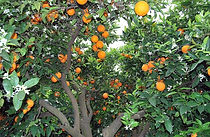
All citrus trees belong to the single genus Citrus and remain almost entirely interfertile. This means that there is only onesuperspecies that includes grapefruits, lemons, limes, oranges, and various other types and hybrids.[10] As the interfertility of oranges and other citrus has produced numerous hybrids, bud unions, and cultivars, their taxonomy is fairly controversial, confusing or inconsistent.[8][11] The fruit of any citrus tree is considered a hesperidium (a kind of modified berry) because it has numerous seeds, is fleshy and soft, derives from a single ovary and is covered by a rind originated by a rugged thickening of theovary wall.[12][13]
Slices of a Navel orange
Different names have been given to the many varieties of the genus. Orange applies primarily to the sweet orange – Citrus sinensis (L.) Osbeck. The orange tree is an evergreen, flowering tree, with an average height of 9 to 10 m (30 to 33 ft), although some very old specimens can reach 15 m (49 ft).[14] Its oval leaves, alternately arranged, are 4 to 10 cm (1.6 to 3.9 in) long and have crenulate margins.[15] Although the sweet orange presents different sizes and shapes varying from spherical to oblong, it generally has ten segments (carpels) inside, and contains up to six seeds (or pips)[16] and a porous white tissue – called pith or, more properly, mesocarp or albedo—lines its rind.[17] When unripe, the fruit is green. The grainy irregular rind of the ripe fruit can range from bright orange to yellow-orange, but frequently retains green patches or, under warm climate conditions, remains entirely green. Like all other citrus fruits, the sweet orange is non-climacteric. The Citrus sinensis is subdivided into four classes with distinct characteristics: common oranges, blood or pigmented oranges, navel oranges, and acidless oranges.[18][19][20]

Lemon Tree
Kinds of Citrus genus belonging to the Rutaceae family and tribe Citreae. All members of the tribe have a characteristic wrist, hesperidin, which is sort of rail with color yellow and the skin is not detached from the flesh. These species are the lemon, the lime and the votryokarpo. The lemon is a cultivated hybrid deriving from wild varieties such as citrus and mandarin. The lemon tree comes from central India, where cultivated and the first trees.
The lemon tree can grow up to 6 meters high but is usually shorter. The branches have thorns, the leaves are green and shiny. The flowers are white externally, while internally tend to purple.

Maple Tree
Platanos is a genus of trees native of the northern hemisphere. The subclasses of this kind belong to the family of Platanoeidon.
These large trees with a height ranging from 30 to 50 meters, deciduous (excluding type P. kerrii) and occur on riverbanks and generally in wetlands, but can survive drought. The hybrid nature of the London plane tree fits without problems in an urban environment, but generally most species.
In Europe it is known by the name tree, while in North America under the name of sycamore. (Except North America the name "sycamore" refers to either the nature ficus (Ficus sycomorus) or type or Great Sycamore Maple (Acer pseudoplatanus).

Golden Oak
Golden oak (scientific. Klithrofyllos the Oak, Quercus alnifolia Poech) is a species of oak maquis that grows in Cyprus. The Latin name is due to the shape of leaves resembling that of alder. The Quercus alnifolia is endemic plant of Cyprus and its spread is limited to igneous rocks of the Troodos Mountains. In February 2006, by decision of the Cabinet of Cyprus, the golden oak was declared the national tree of Cyprus. [1]

Olive Tree
The olive or olive or olive (scientific. Elea, Olea) is fruitful tree genus of the family of oilseeds (Oleaceae), which occurs very often in Greece. The fruit of the olive tree also called him and produced olive oil. The olive tree has been the symbol of the goddess Athena.

Almond Tree
The Almond tree is a species of plant family of rosacea sometimes included in the genus Proumni. The commonest type is the Proumni the sweet (Prunus dulcis, synonyms: Prunus amygdalus, Amygdalus communis) that grows in almost all the hot and dry regions of Paramesogeiaki zone where cultivated since ancient times. Therefore define its place of origin is very difficult. It is a deciduous tree with a height of 4 to 12 meters, trunk diameter up to 30 cm and oval leaves, lanceolate and serrated.
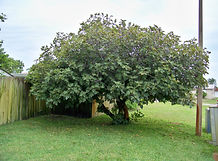
Fig Tree
The fig tree (scientific. Siki Siki the Carian and the common, Ficus carica) is a dicotyledonous plant belonging to the genus Siki and family Moreoeidi. Tree is very common in Asia, the Middle East and Mediterranean countries. Its cultivation was introduced in America in the 18th to 19th century. Is Siki Sykea or ancient. It thrives in areas with warm and cool climate and at altitudes up to 1700m. The fruits are eaten fresh or dried.

Carob Tree
Teratsia or carob. Long-lived tree, polygamous, monoecious or dioecious, native to the Mediterranean. Grown easily and thrives in all soils except liquids and destitute. The fruiting usually starts 6-7 year and continues for many years. The ripening lasts almost a year since Autumn done blooming until late August of the next year the more mature fruits begin to fall. The carob tree is a kind of forest, agricultural, industrial and ornamental. The wood charcoal gives excellent quality, the kardioxylo is used in furniture, wood carving, the turning and cooperage while the bark and leaves of the vrysodepsia and dyeing. Locust beans used as animal feed and manufacture of alcoholic beverages, carob and chocolate.


